

Talent Spotlight · Horror / Thriller
Genre fans know the feeling: a creature steps into frame, and the room goes quiet. Sometimes the face behind the mask stays a mystery. Ross Mullan has built a career in that space: bringing memorable monsters to life across Game of Thrones, Doctor Who and more. Now, he joins the ensemble of Andromedia Studios’ horror thriller Storm Warning.
It is a natural next chapter for a performer whose work has reached audiences through iconic creatures, expressive puppets and characters that do not need a long speech to make an impression.
From Montreal theatre to movement work
Born in Montreal on January 5, 1967, Mullan began with theatre. He attended Children’s Theatre in Montreal’s West End, studied theatre at John Abbott College, then continued at Ryerson University. After university, he moved to Ottawa and worked with Odyssey Theatre, developing skills in mask and puppet movement.
That training matters. A masked performer cannot rely on facial expression alone. Movement, rhythm and physical presence have to do more of the storytelling. The body becomes the character’s voice.
After a vacation in the UK, Mullan moved there and began touring with theatre companies across Europe, the Middle East and Asia. His musical theatre work included David Copperfield, Gulliver’s Travels and Sherlock Holmes. Stage credits followed, including Orsino in Bath Theatre Royal’s Twelfth Night, the title role in Leicester Haymarket Theatre’s The Selfish Giant, and sold-out New York performances of Thick after its Edinburgh Festival run.
For fans of creature performance, that route offers a useful clue: before the prosthetics, there was the movement. Mullan’s career overview and film and television credits trace a path that crosses theatre, puppetry and screen work.
The White Walkers: a face beneath the frost
Mullan’s most widely recognized genre work may be his White Walker performances in HBO’s Game of Thrones. He appeared in seasons 2, 3 and 4, including “Valar Morghulis,” “Second Sons” and “Oathkeeper.” The creatures became signature images of the series: silent, icy figures whose arrival could make a battlefield feel suddenly much smaller.

The effect was not simply a digital creation. In a 2014 interview with The Verge, Mullan described the physical work involved in performing under extensive prosthetics and makeup. The transformation took hours, and the actor had to make the creature feel present through stance, gesture and movement, not through a readable human face.
That combination helped turn a mostly silent role into a fan-recognizable performance. Mullan later discussed how performance choices helped shape the Walkers in a SyFy Wire interview. For audiences, the result was chilling. For actors and filmmakers, it is a reminder that practical creature work still depends on a performer making every movement count.
A Doctor Who gallery, and creatures beyond it
Mullan’s genre credits extend well beyond Westeros. In Doctor Who, he played the Silence, the Teller, an Ice Warrior and a Wraith. Each role called for a different physical presence, from uncanny stillness to the shape and movement of a distinctly nonhuman character.

His film creature work adds another run of vivid transformations. He played Pemphredo, one of the three blind Stygian witches, in Clash of the Titans (2010), and one of the werewolves in Howl (2015). In A Monster Calls, he performed monster motion-capture, bringing a character to life through movement in a different production process.
Then there are the memorable turns that happily ignore any single genre lane: Dr Wobbegon in Sharknado 5; the Maitre D’ in Ant-Man and the Wasp: Quantumania; and Karthus in League of Legends. He has also provided voice work for Payday and narrated the 2003 video game Ghost Master.
The range is the point. Mullan’s credits connect horror, fantasy, science fiction and comedy, with the same central challenge running through them: give a character a clear physical identity, then make audiences believe in it.
From Nev the Bear to the Numbertaker
Some of Mullan’s best-known characters were made for younger viewers. He played Nev the Bear on the BBC’s Smile in 2002 and Bear Behaving Badly in 2007. He also performed the Numbertaker in the children’s series Numberjacks.
That family-friendly work shares a core skill with his more frightening roles. A puppet or costume can give a character its shape, but the performer supplies its personality. Mullan also worked on Dinotopia, where the effects team sought someone who could animate a dinosaur and make it emote like a person. Not every creature needs to stalk a castle. Some just need to land a look.
The craft is in the performance
Creature effects can start with sculpture, fabric, paint, puppetry or digital tools. But the audience responds to a character, not a production method. As Mullan’s interviews describe, prosthetics-heavy performance is physical acting: the performer works within the limits of the design, finding the gestures and movement that make the creature feel alive.
His mask-theatre background is especially relevant here. The mask changes what a performer can show, so movement has to carry meaning. That is a powerful fit for horror, where a small turn of the head or a steady approach can make a scene more unsettling than a burst of noise.
For genre filmmaking, practical creature work also gives performers something tangible to react to. That physical connection can help ground a fantastic image in a scene. It is one reason an actor with Mullan’s experience brings a distinctive toolset to a production built around horror and practical effects.
Bringing that experience to Storm Warning
In Storm Warning, a hidden SS experiment unleashes undead Nazi stormtroopers in present-day Canada. A local constable, a doctor and other residents must defend a church against the creatures. The horror thriller is written by Bill Dever, produced by Sam Dever and directed by Drew Antzis, with cinematography by Jack Peresin.
Mullan joins an ensemble led by Kate Mayhew and Marc Rico Ludwig, alongside Curtis Harrison, Eddie Curry, Lambros Bryan Demos, Jemilla Mills-Smith and fellow genre performer Rick Bland.
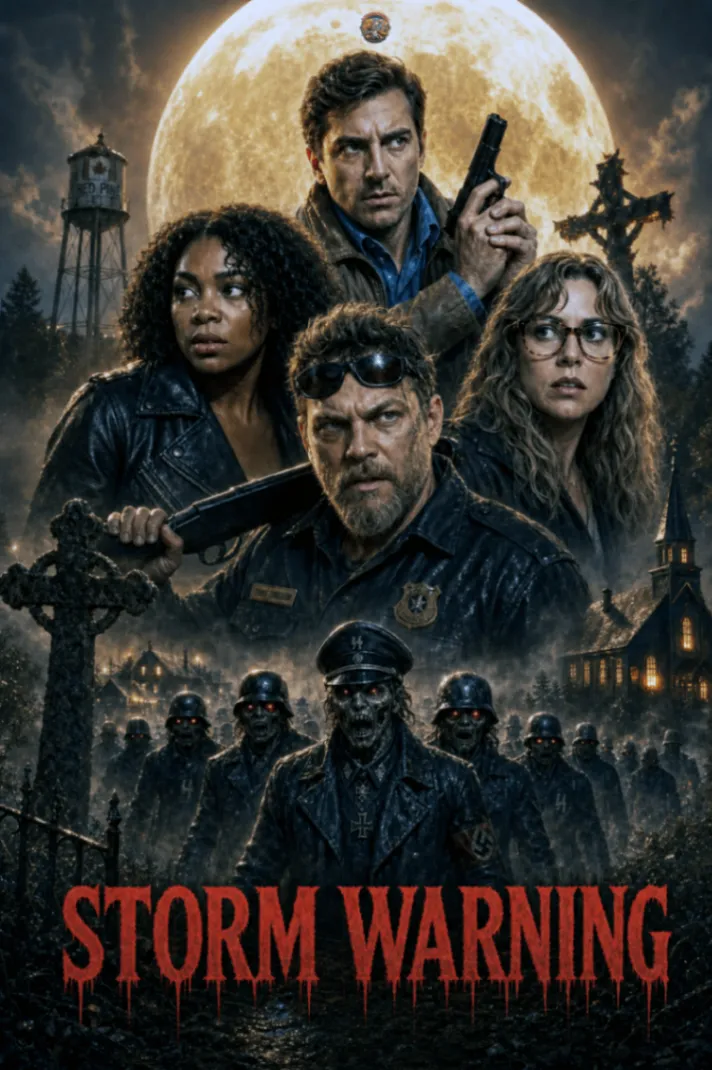
Andromedia announced the completion of principal production on June 2, 2026. The studio describes the film as balancing psychological tension with visceral horror, using high-quality practical effects to honour classic horror traditions while keeping the story fresh and contemporary. Its Storm Warning project page has more about the film and its creative team.
Mullan’s castmate Eddie Curry has publicly called working with him “one of the real highlights of working on Storm Warning” in a LinkedIn post. Andromedia’s production announcement also notes the marketability of Mullan and Bland, whose work connects the film to recognizable genre franchises including Game of Thrones, Doctor Who and Star Wars.
For an independent film production, that connection matters. A performer with a deep genre résumé brings both craft and a point of recognition for fans. Andromedia is building a slate of genre movies for audiences beyond one market, with an outward-facing mix of horror, thriller and other projects. It is a focused approach for an indie film production company: make the premise easy to grasp, bring experienced genre talent into the frame, and give fans a reason to follow the work. Whether a project leans into practical horror or science fiction, the same principle holds: strong character work makes the spectacle stick.
One creature at a time
Ross Mullan’s career has moved from Montreal theatre to touring stages, children’s television, fantasy franchises and creature features. Across those settings, he has built characters through physical presence: sometimes beneath layers of prosthetics, sometimes inside a bear suit, always with the performer’s work at the centre.
Now that legacy meets a Canadian indie horror thriller. Genre fans can look forward to seeing what a seasoned creature performer brings to Storm Warning, and to the next unforgettable shape that steps out of the shadows. For more on Andromedia Studios and its projects, visit the studio slate.